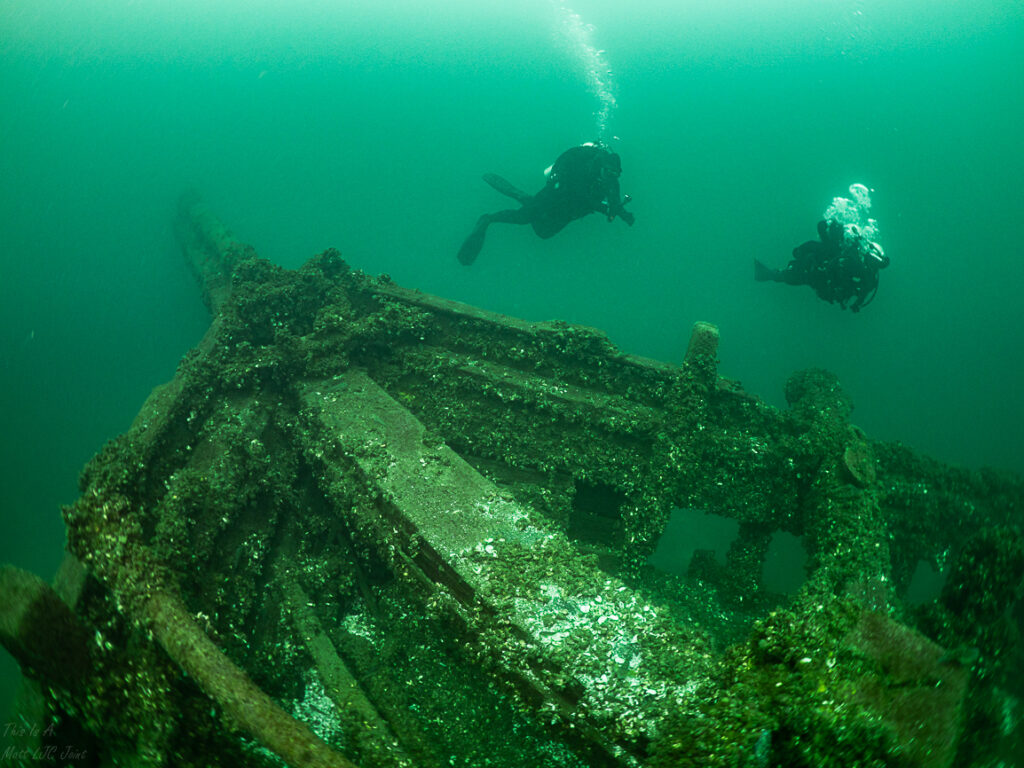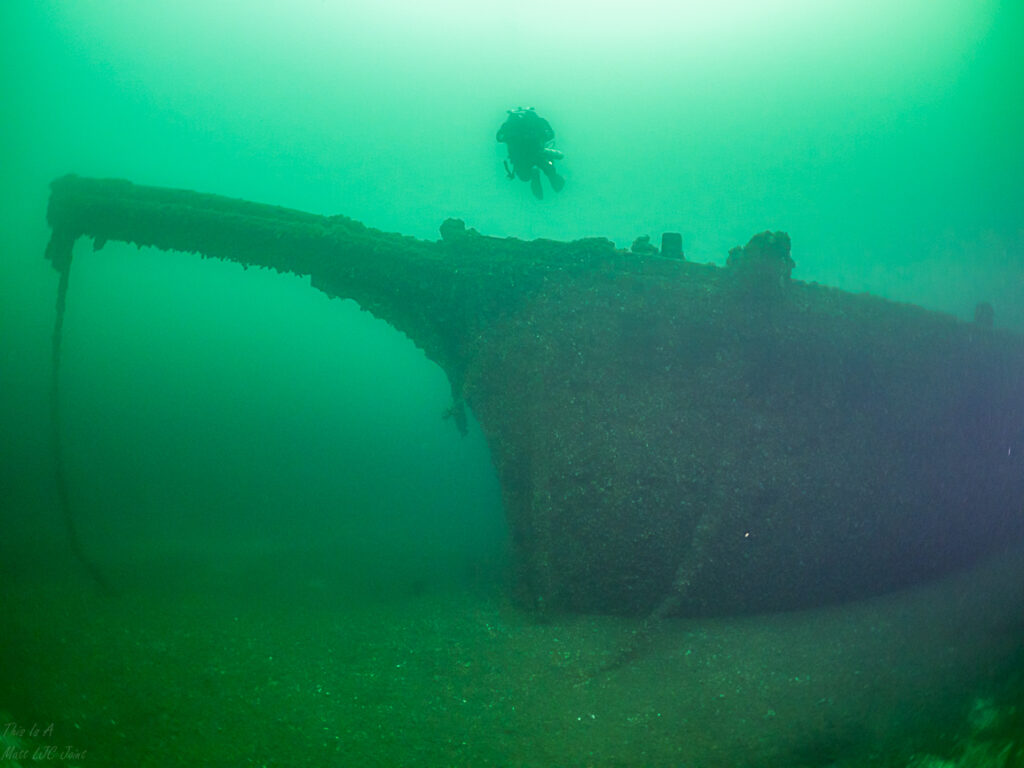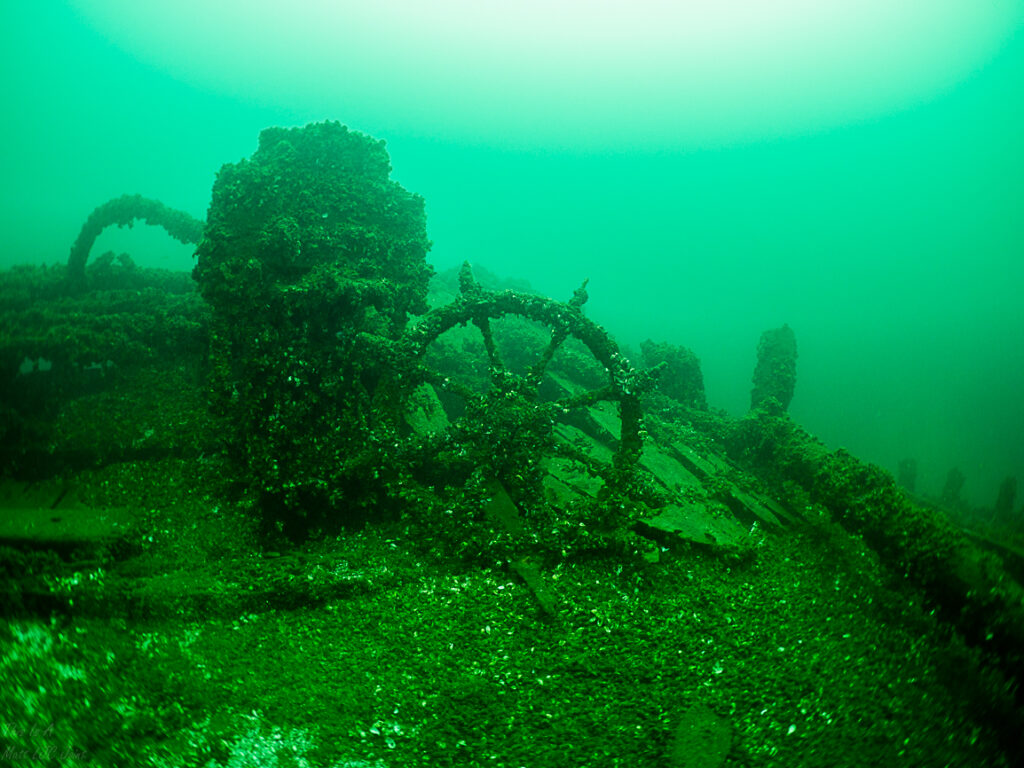
The George A. Marsh was a three-masted wooden schooner that sank in a gale just west of Kingston, Ontario, at about 5 a.m. on August 8, 1917. Twelve of the 14 people aboard died, most of them women and children from the captain’s and a deckhand’s families. It was one of the deadliest schooner losses in Lake Ontario’s history.
She was built at Muskegon, Michigan, in 1882 and spent three decades in the Lake Michigan lumber trade. In 1914 she was sold to owners in Belleville, Ontario, and put to work hauling coal across Lake Ontario. On her last trip she was carrying about 450 tons of coal from Oswego, New York, to Kingston’s Rockwood Hospital. In heavy seas her old seams opened, and she sank between Nine Mile Point on Simcoe Island and Pigeon Island, within sight of Kingston harbour.
The wreck was never salvaged. Divers relocated it, probably in the 1960s, and found it sitting upright and largely intact in about 75 to 85 feet of water. Today it is one of the best-known wreck dives in the Kingston area. It is also a protected heritage site and a grave, since several of the victims were never recovered.
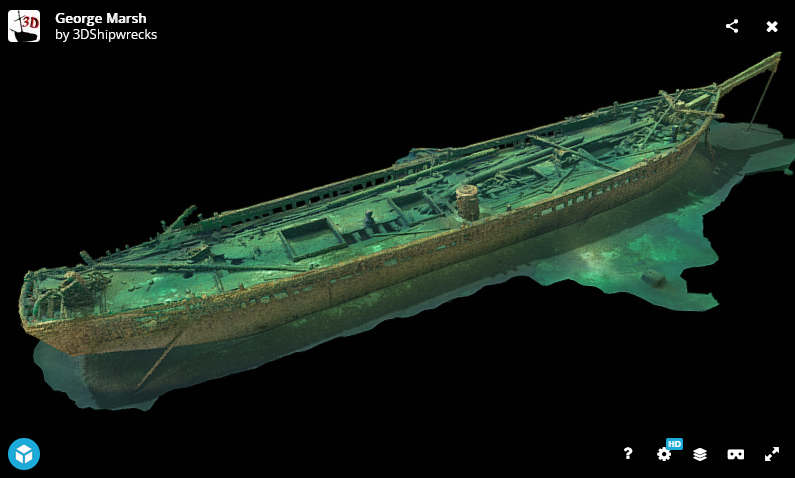
3D Photogrammetry Model
Construction details
- Year built: 1882
- Built at: Muskegon, Michigan
- Built by: A.J. Footlander
- Vessel type: Wooden
- Rig: Three-masted schooner
- Official number: 85727 / 133750 (from 1914)
- Nation of registry: United States / Canadian
Dimensions
- Length: 118.00 ft
- Beam: 31.00 ft
- Draft: 09.00 ft
- Gross tonnage: 175
Loss
In August 1917 the Sowards Coal Company of Kingston needed a cargo moved after its usual carrier was unavailable, and it hired the Marsh. She loaded about 450 tons of coal at Oswego for Rockwood Hospital in Kingston and set out across the lake.
Fourteen people were aboard. Like many small schooners of the era, she carried family members along with the crew. They included Captain Smith, his young wife, and their five children; the mate, William J. Watkins (66); deckhand George Cousins (59); deckhand Neil McLennan, with his wife, their infant, and his nephew George “Buster” Graves; and the captain’s brother, William Smith.
During the night of August 7–8 an unusual summer gale, reported at about 35 miles per hour, swept eastern Lake Ontario. The old schooner worked hard in the heavy seas, and her seams opened. The pumps could not keep up. At about 5:00 a.m. on Wednesday, August 8, she filled and went down between Nine Mile Point on Simcoe Island and Pigeon Island, about two miles off Long Point on Amherst Island. Kingston harbour was within sight.
The newspapers of the day called it the worst loss of life in a Lake Ontario schooner in a generation. A Belleville paper quoted survivor Neil McLennan saying that a few more boat-lengths would have saved them all. The Marsh went down not far from where the schooner City of Sheboygan had been lost with all hands two years earlier.
Survivors and Victims
Only two people survived: Neil McLennan and William Smith, the captain’s brother. Amherst Island fishermen Hugh McCartney and Benjamin Wemp pulled them from the water. The captain’s dog was also rescued.
Twelve people died: Captain Smith, his wife, and their five children; Mrs. McLennan, her baby, and young George Graves; mate William Watkins; and deckhand George Cousins. Some bodies were recovered from the lake in the days that followed. Others were never found and are believed to remain with the wreck.
A long-running local legend says Captain Smith was not lost at all. In this story he survived, and out of shame lived the rest of his life in the United States under another name. Some dive guides repeat this, but it has never been verified, and the 1917 newspapers list him among the dead.
The Dominion government opened an inquiry and sent the government steamer Grenville to the site. Because the wreck sat upright in fairly shallow water, her masts and rigging stuck up above the surface and were a hazard to shipping. Officials talked about dynamiting the hull if it blocked traffic. In the end the masts were cut away and dropped on the lake bottom beside the hull. The schooner was valued at about $5,500, and salvage was judged too costly, so she was left where she lay with her cargo of coal.
Location and depth
- GPS: 44.126836, -76.602797
- Depth: 75-85 ft
Diver notes
The George A. Marsh is widely considered one of the best wreck dives in the Kingston area. She sits upright on the bottom in about 75 to 85 feet of water. Visibility is often 30 to 40 feet or better.
- The hull is largely intact. Some damage is visible on the port side near the stern.
- The bowsprit still carries chain and rope, though some of this fell away in 2013.
- The ship’s wheel has come loose and stands free near the stern.
- The capstan, anchor windlass, galley stove, deadeyes, and pots and pans remain on deck.
- The masts lie on the bottom alongside the hull, where they were dropped in 1917.
- Invasive zebra and quagga mussels now cover much of the wreck. They obscure detail and have sharp edges.