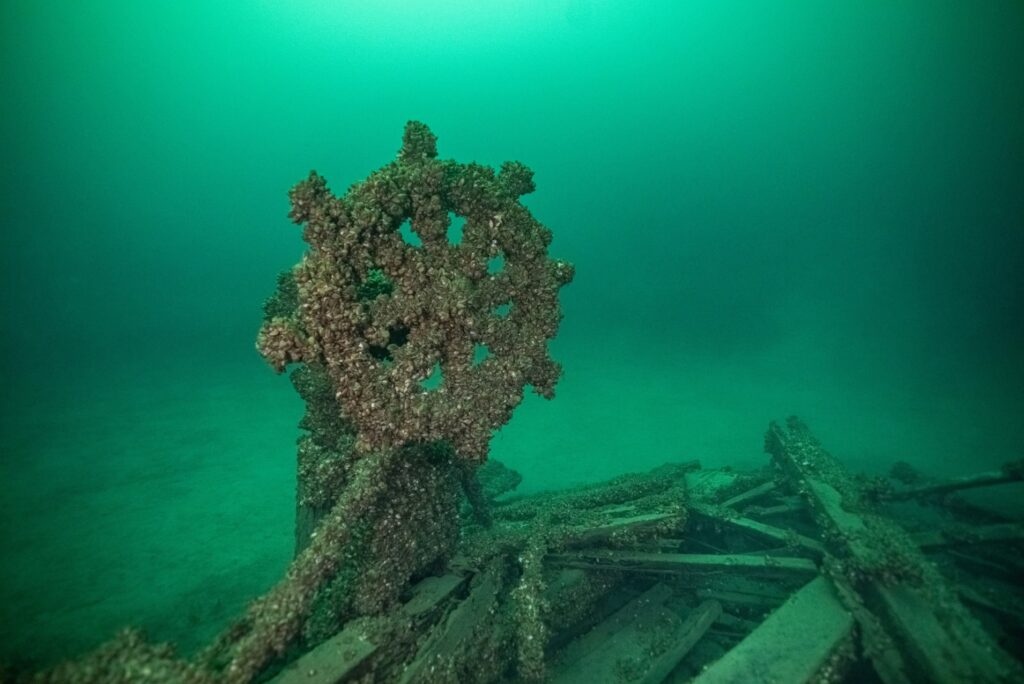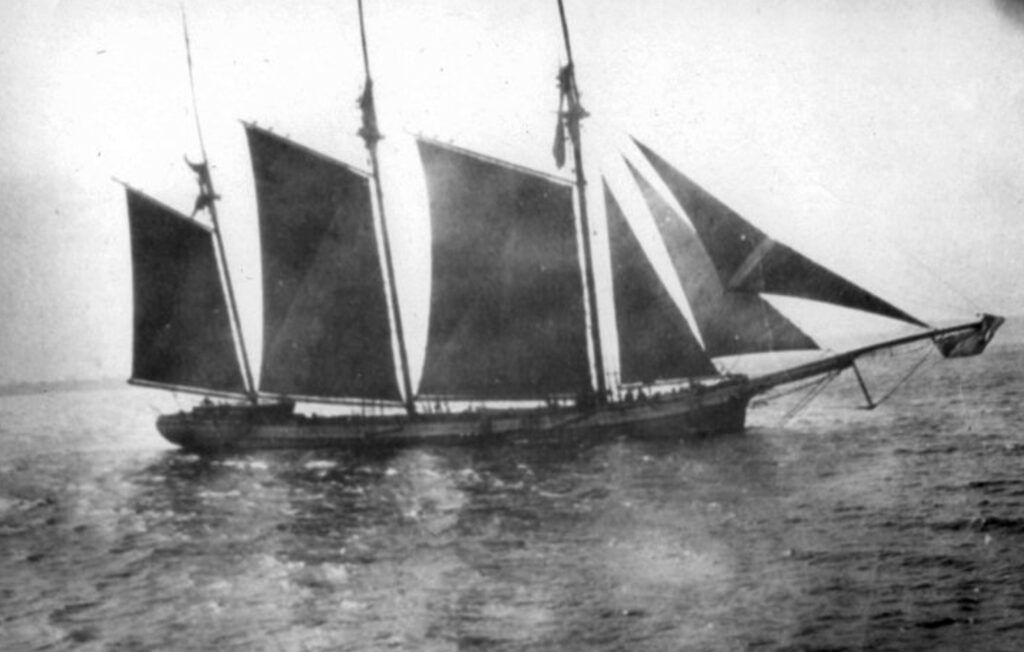
The three-masted schooner OLIVER MOWAT (Canadian No. 92584) was considered the crown jewel of the Millhaven shipyards when she was launched on July 16th, 1873. No expense was spared in her construction since she was to showcase the design and building skills of the Millhaven shipwrights who were competing with the mighty Portsmouth yards just miles away. Named after Sir Oliver Mowat, one of the Fathers of Confederation her career would span 48 years until her collision on September 1st, 1921 with the steamer KEYWEST. At that time there were only 400 sailing ships left registered on the Great Lakes, so she represents the last of the three-masted schooner era.
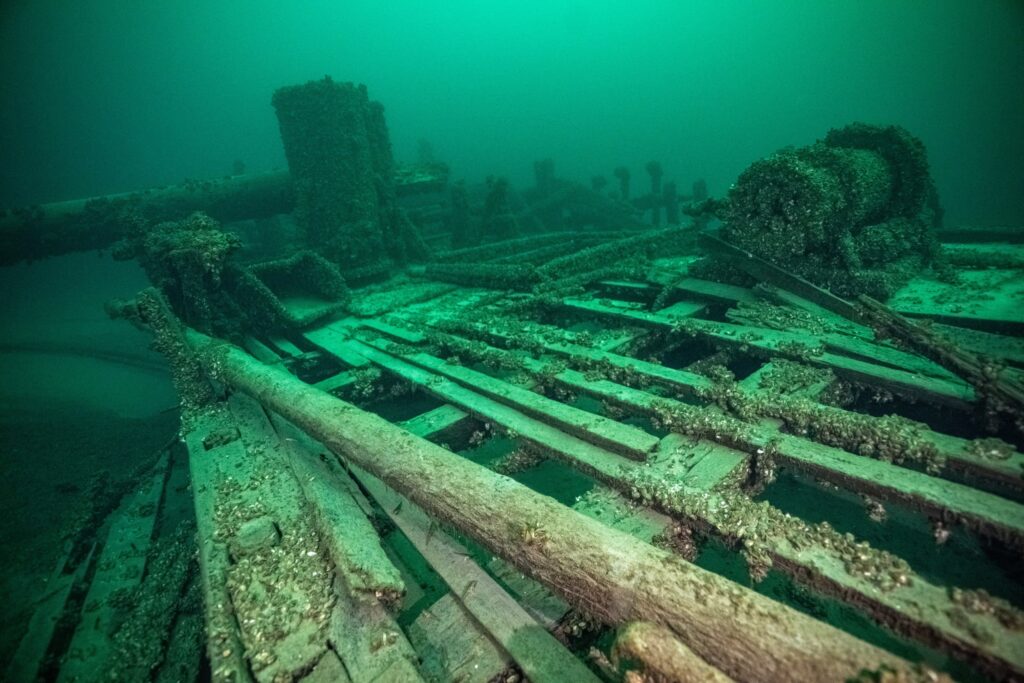
Since her loss in 1921, she has been considered the holy grail for shipwreck hunters of the region. After 25 years of searching, her location was discovered on June 12th, 1996 by Barbara Carson, Tim Legate, Spencer Shoniker and Rick Neilson along with their friends Susan Donnelly and David Teeple. The location was kept secret for decades to protect the numerous artifacts ranging from twin anchors at the bow to the ship’s wheel aft. On deck, everything from oil lanterns to crockery could be seen. On June 16th 2024, diving on this time capsule of history was opened to the public with the placing of a mooring block and buoy by Kayla Martin and a team of volunteers from the S.O.S. Picton Chapter.
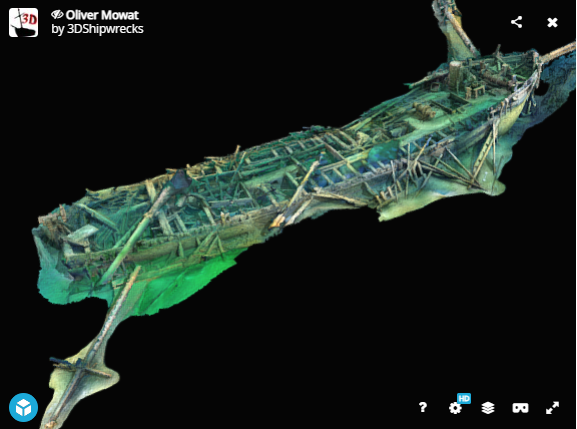
3D Photogrammetry Model
Construction details
- Year built: 1873
- Built at: Millhaven, Ontario
- Built by: The firm of Fraser & George
- Vessel type: Wooden
- Rig: Three-masted schooner
- Official number: 92584
- Nation of registry: Canadian
Dimensions
- Length: 131.20 ft
- Beam: 25.90 ft
- Draft: 10.80 ft
- Gross tonnage: 295
Loss
On the afternoon of Thursday, September 1, 1921, the Oliver Mowat left Picton for Oswego, New York, sailing light (empty) to load coal, the kind of run she had made for years. The night was clear but dark, with only a sliver of moon.
Shortly before 11 p.m., near the Main Duck Islands, the steel steam freighter Key West of the Keystone Transportation Co. of Montreal came up from the east. The schooner signalled, but the freighter held her course and struck her amidships, cutting her nearly in two. Reports differ on how fast she sank, from seconds to about nine minutes. Either way, the crew had almost no time.
Lost were:
- Capt. Thomas Lake Van Dusen, about 65, of Picton
- Mate Jacob Corby of Deseronto
- Cook Carrie McGuigan, reported to be from Niagara Falls, who was trapped below deck
Two deckhands survived. John Minaker of Picton had a life preserver. George Keegan of Belleville did not, and Minaker threw him a plank. The Key West lowered a boat, threw rope ladders and searched until hope was gone, then carried the two survivors on to Port Dalhousie at the Welland Canal.
Days later, two of the schooner’s three masts still stuck up out of the water, marking the spot. They were a hazard to navigation and were later dynamited. Her registry was closed on October 5, 1921, noting that her certificate and papers had gone down with her.
The inquiry
The Dominion Wreck Commissioner, Capt. L.A. Demers, held an inquiry in Montreal with assessors Charles Lapierre and Arthur Lefebvre. Its central questions were whether the schooner’s lights were lit and visible. The Key West reported seeing none, while the Picton account says she showed her usual lights. Testimony showed both crews did what they could to save lives. The Commissioner ruled the deaths accidental, a result of the collision. He praised Capt. Van Dusen, finding that he had stayed aboard to help the trapped cook, and that Corby had likely stood by his captain.
Lost, then found (1921–1996)
With the masts gone and only rough positions recorded, the wreck’s exact location was lost. For decades she was one of the most sought-after wrecks in eastern Lake Ontario.
On June 12, 1996, after roughly 25 years of searching, a team of divers found her: Barbara Carson, a Prince Edward County-born diver, with Tim Legate, Spencer Shoniker, the late Rick Neilson, Susan Donnelly and David Teeple. As was the custom then, they kept the location secret to protect the site.
Documentation and public access (2023–2024)
Carson eventually entrusted the site to a team led by Kayla Martin, an environmental scientist at the University of Waterloo and a heritage ambassador for Save Ontario Shipwrecks. Her one condition was that they install a secure mooring so divers would not damage the wreck with anchors.
- Summer 2023: Martin led an expedition funded by the Royal Canadian Geographical Society, with support from Save Ontario Shipwrecks and the Ontario Marine Heritage Committee.
- September 2023: Kayla and Durrell Martin photographed the site for a 3D photogrammetry model. The finished model, built from 9,485 images and covering the whole site, was released in March 2024 at 3dshipwrecks.org.
- Late 2023 to 2024: Working with the Canadian Coast Guard, the team placed an approved mooring block at the site, followed by a mooring buoy, opening the wreck to visiting divers. The Coast Guard now issues navigational warnings about the buoy marking the Oliver Mowat near Main Duck Island.
Location and depth
- GPS: 43.932633, -76.707850
- Depth: 121 ft
Diver notes
The bowsprit is intact with the port anchor in place on the deck and the starboard anchor hanging from its cathead. The ship’s wheel is upright and, on the deck, can be seen the windlass, donkey boiler, steam powered winch along with pulleys, deadeyes and a fife rail with belaying pins. On deck, everything from oil lanterns to crockery can be seen.
VISIBILITY: 9m-25m (30’-80’). Spring and early summer bright on the
bottom. Mid-summer to fall dark on the bottom, must bring a light. Penetration of this wreck is not recommended.
DEPTH: The wreck is upright on the bottom in 121 feet of water. Most the dive is at the deck level which rises to 114 feet.
Mooring block is located starboard side at midships.